Amount awarded: $13,340
Project Narrative: Humans are now forming companionships with generative AI. These bonds feel real, are reported sincerely, and are proving consequential for wellbeing. This project will organize an interdisciplinary workshop to help establish a better understanding of the cognitive and neural mechanisms by which AI companions evoke bonding mechanisms and sustain human attachment, and the philosophical significance of AI companions in that light.
Project Summary: Our project seeks to drive progress in understanding the psychological and neurological mechanisms of AI–human bonding. Recent surveys show that 72% of American teens use AI companions, with more than half using them regularly, and with older age groups showing similar trends (Robb and Mann 2025). And with tens of millions of people using LLMs for some form of companionship (Chatterji et al. 2025), the number of specialised LLM companionship apps has surged by 700% between 2022 and 2026 (Andoh 2026). Recent psychological studies have linked this rise in LLM companionship with concerns about psychological wellbeing, including increased loneliness and self-reported dependence (Croes and Antheunis 2021; Herbener and Damholdt 2025; Hu, Mao, and Kim 2023; Laestadius et al. 2024; Phang et al. 2025; Skjuve et al. 2021, 2022; Xie and Pentina 2022; Xie, Pentina, and Hancock 2023). The prevalence of LLM-“companionship” among more and more people raises a pressing, interdisciplinary question: how do AI tools induce such strong attachments?
We propose to organise an invited, interdisciplinary workshop and special issue directly exploring this question. We aim to build connections between the basic science of human–AI bonding and the philosophical and clinical understanding of human bonding and personal relationships. The special issue will publish the contributions from our speakers, focusing on high-level research directions that incorporate insights from multiple disciplines including neuroscience, psychology, philosophy, and clinical practice. And in the run-up to the conference we will organize a reading group for the speakers, introducing them to each others’ fields and research to prepare the way for fruitful contributions and discussions at the workshop.
We believe this is an important time for an effort like this. As LLMs and companion apps are increasingly used for emotional support, therapy, and other interpersonal roles, we need rigorous, humanistic, and robustly interdisciplinary research on the nature of human–AI bonding to understand the meaning, significance, and mechanisms of AI–human relationships. But, unfortunately, while the (e.g.) ontology and moral significance of AI companions are being explored in philosophical domains, much philosophical work remains largely uninformed by empirical work on human–AI bonding, and vice versa. Our workshop and special issue would aim to spur research on human–AI bonding that builds on sound philosophical foundations, in collaboration with psychological and clinical work, and in fruitful directions.

Andrew Richmond, PhD, Lecturer in Philosophy, University of Otago

Caitlin Mace, PhD Candidate, University of Pittsburgh, Department of History and Philosophy of Science
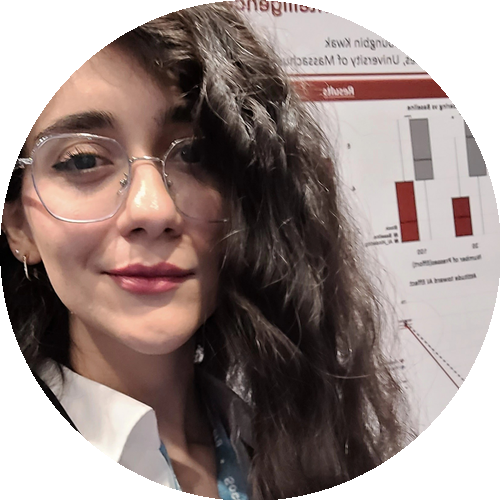
Roya Mohammadsadegh, PhD Candidate, University of Massachusetts Amherst, Psychology and Brain Sciences Department

Ben White, PhD, AI Fellow, Université Paris Dauphine-PSL